The leaky boat has been fixed and we're up and sailing! The kids are at the helm whilst their teacher manns the lifeboat-so far she's the only one that 's really needed it!
Overall, the students in 5A have responded very well. They have all managed to produce some very appropriate and cleverly designed games and have all been very keen to work on and finish their games. Many of the students have given up lunchtimes to work on their projects in the classroom.
We've only lost the keel a couple of times in that a couple of children have found it somewhat stressful. I think that's due to the time frame and speed at which they had to accommodate the 'new language' of Kahootz.
On the other hand, one parent said that 'Kahootz' is her son's favourite time of the week!
Both of the children who have been chosen to present their Kahootz expressions at the ICT Conference in the school holidays have been more than happy to write speeches and prepare for their presentations.
For myself, I have learned to overcome my initial trepidation and am keen for my kids to teach(re-teach) me, during my lunchhours, to create an 'expression'. I'm now keen to master this foreign language!
A suggestion I have for the future, is to slow down the teaching/learning time to enable all students, of varying abilities(and ages!!), to feel confident about their skill acquisition and subsequent ability to design their own game. Minimise stress, maximise participation!
I feel the project has been very worthwhile as it has added a new dimension to my students' learning and a new medium for problem solving and creative expression ie curriculum enrichment. Many thanks to Cathie and Anthony, (the lighthouses!), for their constant guidance and creation of the project. ...Glad to have been invited aboard!
Friday, June 25, 2010

Wednesday, June 23, 2010
Game Design with Year 6 at Cromer Public School
My Year 6 class have been busy this year designing and building games using Kodu.
To give you a little bit of background information on my students, last year, in Year 5, they were involved in the MacICT Game Design project with Kahootz. My students built games related to many aspects of the curriculum including:
- literature, particularly the book Rowan of Rin by Emily Rodda
- micro-organisms
- maths
- spelling
A few of my students created the Prezi below for our class blog about using Kodu to design games.
We also set up a wall in wallwisher where the students reflected on what they had learnt on their journey into game design and some of the challenges they faced.
Next term, some students will go onto designing games in Kodu or Kahootz as part of a rich task related to our Science unit on sustainability, 'Cool Kids for a Cool Climate'.
Tuesday, June 22, 2010
Let's Make a Game! - Part 1: Ideas, Man
I'm going to mix it up this week. Instead of talking about professional games that already exist, we're going to peer inside the head of a game designer as they actually work. I've been 'volunteered' as a live test subject for this experiment. We'll follow the train of thought that takes place to get from an idea to a game.
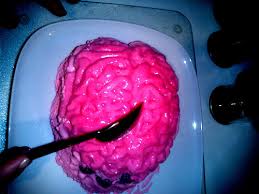
It's full of delicious ideas!

It's full of delicious ideas!
The first step is to sit down and have an idea. This can often be the hardest step. You've got to think of an interesting character, a cool setting or a new way to play. Many ideas won't even make it past this first step, but it's important to write down everything you think of. If you don't use that awesome Gorilla-with-a-Jetpack idea in this game, it might fit in something else.
Or maybe your idea is simply to improve on something that you've already seen. Far from plagiarising, this is actually a fairly common fact of game design. Everyone can make games about soldiers and guns, but what if you were a firefighter and your gun was a firehose? Innovating and building upon existing ideas can be just as valid and important as (and often easier than) coming up with something completely new. The trick is to emphasise what makes this game unique, not what makes it just like everything else.

Remember when Lucy gets lost in snow-covered Narnia and has to find her way back to the street lamp that serves as the signpost back to the wardrobe? Or how about when Edward has to escape from the White Witch after she tricked him into coming back to her castle with the promises of power and turkish delight?

It's full of delicious power!
But that's enough for this week. We'll start next week with a pile of good ideas that are ready to be poked and prodded into something resembling a game.
Stay Tuned!
Anthony
Or maybe your idea is simply to improve on something that you've already seen. Far from plagiarising, this is actually a fairly common fact of game design. Everyone can make games about soldiers and guns, but what if you were a firefighter and your gun was a firehose? Innovating and building upon existing ideas can be just as valid and important as (and often easier than) coming up with something completely new. The trick is to emphasise what makes this game unique, not what makes it just like everything else.
We're going to start with an idea from a book. One of the benefits that comes from teaching game design is that it's so easy to tie in whichever fantasy book your class is currently reading. We'll take The Lion, the Witch and the Wardrobe. Take a moment and try to think back to what happens. What exciting things happen to the main characters? What difficult things befall them? What choices do they have to make?
Remember when Lucy gets lost in snow-covered Narnia and has to find her way back to the street lamp that serves as the signpost back to the wardrobe? Or how about when Edward has to escape from the White Witch after she tricked him into coming back to her castle with the promises of power and turkish delight?
It's full of delicious power!
What other exciting events happened in the book?
Once we've found a couple of cool story ideas you've got to stop and ask yourself a question. "It was exciting when I was reading about this, but how would it feel if this was really happening to me?" This is the key distinction between a book and a game. In a book, the reader is rarely a character in the book, rather they are a detached observer. In a game, the player is the star. They are front and centre when things go well and when disaster strikes.
When the player feels scared it's because there's scary things in front of them. When they feel victorious it's because they've struggled and succeeded against difficult puzzles and obstacles. Emotions are very personal for the player. How would you feel if you were lost in Narnia hunting for the lamppost? How would you feel if you had been tricked and kidnapped by the evil White Witch?
You want your player to feel exactly like that.
Once we've found a couple of cool story ideas you've got to stop and ask yourself a question. "It was exciting when I was reading about this, but how would it feel if this was really happening to me?" This is the key distinction between a book and a game. In a book, the reader is rarely a character in the book, rather they are a detached observer. In a game, the player is the star. They are front and centre when things go well and when disaster strikes.
When the player feels scared it's because there's scary things in front of them. When they feel victorious it's because they've struggled and succeeded against difficult puzzles and obstacles. Emotions are very personal for the player. How would you feel if you were lost in Narnia hunting for the lamppost? How would you feel if you had been tricked and kidnapped by the evil White Witch?
You want your player to feel exactly like that.
Stay Tuned!
Anthony
Monday, June 14, 2010
Intriguing the Player
The best games tell a story. And the best stories are those that keep you asking for more, where you're desperate to find out what happens next and perhaps a little sad when you get to the end simply because the story's done and there's no more to read.
"And then Ron and Hermione just got married, what a crock."
This week we'll be intriguing and enticing, we'll be talking about games that hook the player in to their world. These are the games that succeed in bringing a world to life.
Capturing your player and drawing them into your world isn't an easy thing to teach. Many people already spend a great deal of their time trying to work out how to teach others how to write a good story. I'm not going to throw my hat into that ring just yet.

What I can do is tell you why a good narrative is a pre-requisite for a great game and an excellent teaching tool. A good story makes your game memorable, dramatic and interesting without being repetitive and there's never the lack of momentum that haunts lesser games. Games with great stories never run out of steam.
But be careful! A great story alone will not save a game if the game doesn't know how to tell that story. There's been a number of games with great stories, and depending on who you ask this either made them fantastic or fantastically boring. Personally, I love a good story, and for that reason I've excused many games such as Alan Wake, Max Payne and Half-Life 2 when gameplay gets in the way of a good story.
And of course we can't talk about stories in games without looking at my personal favourite: the Metal Gear franchise, and particularly Metal Gear Solid 2: Sons of Liberty.

"And then Ron and Hermione just got married, what a crock."
This week we'll be intriguing and enticing, we'll be talking about games that hook the player in to their world. These are the games that succeed in bringing a world to life.
Capturing your player and drawing them into your world isn't an easy thing to teach. Many people already spend a great deal of their time trying to work out how to teach others how to write a good story. I'm not going to throw my hat into that ring just yet.

Start hard with stream-of-consciousness, then two
quick metaphors to the left and an irony uppercut.
quick metaphors to the left and an irony uppercut.
What I can do is tell you why a good narrative is a pre-requisite for a great game and an excellent teaching tool. A good story makes your game memorable, dramatic and interesting without being repetitive and there's never the lack of momentum that haunts lesser games. Games with great stories never run out of steam.
But be careful! A great story alone will not save a game if the game doesn't know how to tell that story. There's been a number of games with great stories, and depending on who you ask this either made them fantastic or fantastically boring. Personally, I love a good story, and for that reason I've excused many games such as Alan Wake, Max Payne and Half-Life 2 when gameplay gets in the way of a good story.
And of course we can't talk about stories in games without looking at my personal favourite: the Metal Gear franchise, and particularly Metal Gear Solid 2: Sons of Liberty.

The brainchild of video game wunderkind and wierdo Hideo Kojima, the Metal Gear series tells the story of rogue secret agent Solid Snake. I've picked MGS2 partly because it wasn't well received by fans when it attempted to take the franchise is a new direction and partly because I'll never forget the time when playing this game late one night, my character got a call on his military comm-phone from his Commanding Officer telling me to turn off my PlayStation and to stop playing the game. I'd gotten so into the story that it came as a shock when his commander called and literally told me to stop playing. It was a confronting moment, but that's what MGS is all about. And no, I'm not going to tell you why. You're just going to have to play the game yourself, but trust me it's worth it.
If you want moments where you're not sure if you're playing a game at all, all brilliantly written into an immersive story, I highly recommend Metal Gear Solid. If you want to come back next week we'll have another piping hot blog post. Next week's focus we're going to sneak a peek inside a real game designer as they work. Thanks for stopping by, see you all again next week.
Stay tuned!
Anthony.
If you want moments where you're not sure if you're playing a game at all, all brilliantly written into an immersive story, I highly recommend Metal Gear Solid. If you want to come back next week we'll have another piping hot blog post. Next week's focus we're going to sneak a peek inside a real game designer as they work. Thanks for stopping by, see you all again next week.
Stay tuned!
Anthony.
Thursday, June 10, 2010
Anne McLaren - Pennant Hills Public School
I'm a year 5 teacher who is currently acting as computer coordinator while our 'real' one is on leave.
I am not actively teaching Kahootz in the computer lab as we have a relieving computer teacher, but all the planning is being done in the classroom and the kids are loving the experience.
We have some fantastic game ideas under way and some of the children are now at the stage of putting some scenes together. All of Stage 3 are participating in the program and the teachers and students are starting to see some progress.
I am not actively teaching Kahootz in the computer lab as we have a relieving computer teacher, but all the planning is being done in the classroom and the kids are loving the experience.
We have some fantastic game ideas under way and some of the children are now at the stage of putting some scenes together. All of Stage 3 are participating in the program and the teachers and students are starting to see some progress.
Wednesday, June 9, 2010
The Secret of the Paradigm Shift
Over the last few weeks, we took a look at what not to do when designing a game. The top ten most common mistakes made by game designers can be found here, here, here and here. Now we're going to do an about face. It's not fun looking at where games went wrong. This week we're going to recongnise the games that got it right, and maybe pick out a couple of hints to take away for our own games.
For this reason, the paradigm shift is a rare occurence. There should be at the utmost one per game, and there has to be a good narrative reason for the rules as they once were to come crashing down on the player. But when done right, a paradigm shift breathes new life into a game right before the end, where it's often most needed.
So who does it right? Alien vs Predator and Rune get the idea of pumping up the player right before the end (sorry, spoilers), but the best example of a paradigm shift lies in the final chapter of BioShock. I'm not going to give away the ending but suffice to say that towards the end the game, and your role in it, is turned on its head. Suddenly enemies are friends and your own survival is no longer the only focus.
Next week we'll be continuing this theme: looking at how games can intrigue and entice the player. Once again, thanks for dropping by, looking forward to seeing you next week.
Stay tuned!
Anthony

Fig 1: Nintendo employees still celebrating release of
Super Mario Bros, 25 years on.
For this reason, the paradigm shift is a rare occurence. There should be at the utmost one per game, and there has to be a good narrative reason for the rules as they once were to come crashing down on the player. But when done right, a paradigm shift breathes new life into a game right before the end, where it's often most needed.

Fig 2: Before the paradigm shift
So who does it right? Alien vs Predator and Rune get the idea of pumping up the player right before the end (sorry, spoilers), but the best example of a paradigm shift lies in the final chapter of BioShock. I'm not going to give away the ending but suffice to say that towards the end the game, and your role in it, is turned on its head. Suddenly enemies are friends and your own survival is no longer the only focus.

Next week we'll be continuing this theme: looking at how games can intrigue and entice the player. Once again, thanks for dropping by, looking forward to seeing you next week.
Stay tuned!
Anthony
Wednesday, June 2, 2010
The 10 most common mistakes made by Game Designers - Part 4
Welcome back for this our last in a line of the top 10 most common mistakes made by Game Designers. Part 1, part 2 and part 3 can be found here, in which we detail the good and the bad. But this week, we're rounding up the list with the ugly. The top two most embarassing mistakes made by everyone, Game Designers included. This week we look at the silly mistakes, the ones that break a game, that seem so minor when you're making the game but stand out so obviously when your player gets their hands on the finished product. Let's roll up our sleeves and dive right in to:
2. Bugs, Glitches and Typos
The game starts. A man named 'Sir Charles the Nite' appears, instructing you to "hant down teh Goulden Mask fo Power". You hop on your trusty steed and head into the dark forest, where you encounter horrible Blood Spiders who aren't so horrible when they just stand there like that or bump into each other. You can just walk right past them! You find the Golden Mask of Power and return it Sir Charles, who takes it gladly then asks you to 'hant' it down again.

"Hant it down and brung it bak too me!"
High-profile sinners: Zero Wing, Max Payne
Why it happens:
Making a whole game takes a lot of time and effort and it's a nightmare working with a deadline looming and your publisher screaming for a finished product. It's amazing that through all this a game gets made at all, so you can forgive the little typos that manage to sneak their way in here and there, right? Of course, it's not only games that fall victim to this. I've submitted many a uni essay, last minute, without bothering to check for typos in the important things, like the heading.
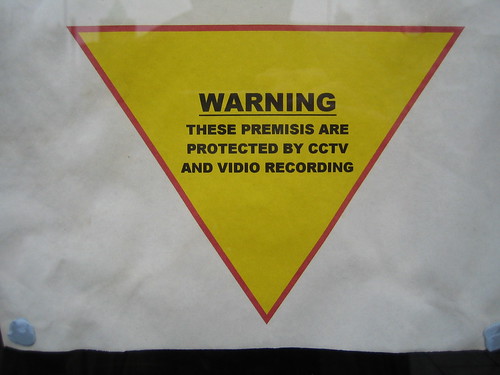
You don't notice it, and frankly you're glad to see the end of it. But your player does (or in my case uni professor). They see these silly mistakes and it's all they can think about. The game itself could be amazing, but somehow your game Dwarf Spelling Forterss has lost some of its glamour. Or maybe it's not spelling, maybe the terrifying Nightmare Guards of the Beyond aren't quite so nightmarish considering they keep bumping into walls and keep getting stuck in invisible holes in the ground.
How to avoid it:
When it comes to avoiding spelling errors, bugs and glitches, the simplest and least helpful response is don't make them in the first place. But not only is that impossible, it ignores the important role of testing your game. Sure, you might be the only person designing or building your game, but you shouldn't ever be the only one testing it. Grab your friends, your parents, your neighbours. Show your game to everyone who will sit still in front of a computer screen long enough. Make them play your game again and again, until they're dead bored with it, and then make them play it again. This isn't about showing off, this is about ironing out the bugs and getting everything absolutely right. And to be honest, it's exactly what professional Video Game Testers get to look forward to every single day.
1. Hogging all the fun
You turn a corner in this dank cave. The sound of dripping water echoes unseen from deep within. Tiny yellow eyes watch your every move from the shadows. You push on, unafraid, towards the mysterious green glow that pulses and hums in the dark. You take one step, then another, and another. And then you might as well put the controller down and make a cup of tea because the next fifteen minutes are going to be dedicated to one long cutscene. Don't get me wrong, this is one incredible cut scene. There's explosions and magic whizzing through the air, and there's a dragon! But the question remains - if this is so cool, why can't we be playing this?

High-profile sinners: Bayonetta, Devil May Cry, Metal Gear Solid 4: Guns of the Patriots
Why it happens:
What is a game if it's not letting you have any fun? It's not a game anymore, it's a movie that stops running if you stop moving your thumbs. Suddenly your player feels a bit like a mouse on a wheel, running round in circles, disconnected from the game. As a side note, these obtrusive cut scenes at their worst dump the player right into the middle of some huge boss fight and expect you to sit through the whole overblown, dramatic fifteen minutes again when you lose - which you will, again and again.
How to avoid it:
Less is more when it comes to cut scenes. There should always be an initial cut scene to quickly introduce the main characters and show off the world. After that cut scenes are handy to show emotional interactions between the heroes and the villains, and that's it. Anything more exciting should be gameplay. It's more engaging and more rewarding and your player will end up caring more about the story when it is shown (through gameplay) and not told (forced down their throat by awkward cut scenes).
And there we have it, the top 10 most common mistakes made by Game Designers. I hope you've enjoyed it, and maybe even learnt something. Next week we'll be looking at how to turn a good game into a great one. Looking forward to seeing you all again next week.
Stay tuned!
Anthony
2. Bugs, Glitches and Typos
The game starts. A man named 'Sir Charles the Nite' appears, instructing you to "hant down teh Goulden Mask fo Power". You hop on your trusty steed and head into the dark forest, where you encounter horrible Blood Spiders who aren't so horrible when they just stand there like that or bump into each other. You can just walk right past them! You find the Golden Mask of Power and return it Sir Charles, who takes it gladly then asks you to 'hant' it down again.

"Hant it down and brung it bak too me!"
High-profile sinners: Zero Wing, Max Payne
Why it happens:
Making a whole game takes a lot of time and effort and it's a nightmare working with a deadline looming and your publisher screaming for a finished product. It's amazing that through all this a game gets made at all, so you can forgive the little typos that manage to sneak their way in here and there, right? Of course, it's not only games that fall victim to this. I've submitted many a uni essay, last minute, without bothering to check for typos in the important things, like the heading.
How to avoid it:
When it comes to avoiding spelling errors, bugs and glitches, the simplest and least helpful response is don't make them in the first place. But not only is that impossible, it ignores the important role of testing your game. Sure, you might be the only person designing or building your game, but you shouldn't ever be the only one testing it. Grab your friends, your parents, your neighbours. Show your game to everyone who will sit still in front of a computer screen long enough. Make them play your game again and again, until they're dead bored with it, and then make them play it again. This isn't about showing off, this is about ironing out the bugs and getting everything absolutely right. And to be honest, it's exactly what professional Video Game Testers get to look forward to every single day.
1. Hogging all the fun
You turn a corner in this dank cave. The sound of dripping water echoes unseen from deep within. Tiny yellow eyes watch your every move from the shadows. You push on, unafraid, towards the mysterious green glow that pulses and hums in the dark. You take one step, then another, and another. And then you might as well put the controller down and make a cup of tea because the next fifteen minutes are going to be dedicated to one long cutscene. Don't get me wrong, this is one incredible cut scene. There's explosions and magic whizzing through the air, and there's a dragon! But the question remains - if this is so cool, why can't we be playing this?

"Hey, I've got this awesome new game, it's called DVD!"
High-profile sinners: Bayonetta, Devil May Cry, Metal Gear Solid 4: Guns of the Patriots
Why it happens:
What is a game if it's not letting you have any fun? It's not a game anymore, it's a movie that stops running if you stop moving your thumbs. Suddenly your player feels a bit like a mouse on a wheel, running round in circles, disconnected from the game. As a side note, these obtrusive cut scenes at their worst dump the player right into the middle of some huge boss fight and expect you to sit through the whole overblown, dramatic fifteen minutes again when you lose - which you will, again and again.
How to avoid it:
Less is more when it comes to cut scenes. There should always be an initial cut scene to quickly introduce the main characters and show off the world. After that cut scenes are handy to show emotional interactions between the heroes and the villains, and that's it. Anything more exciting should be gameplay. It's more engaging and more rewarding and your player will end up caring more about the story when it is shown (through gameplay) and not told (forced down their throat by awkward cut scenes).
And there we have it, the top 10 most common mistakes made by Game Designers. I hope you've enjoyed it, and maybe even learnt something. Next week we'll be looking at how to turn a good game into a great one. Looking forward to seeing you all again next week.
Stay tuned!
Anthony
Subscribe to:
Posts (Atom)